

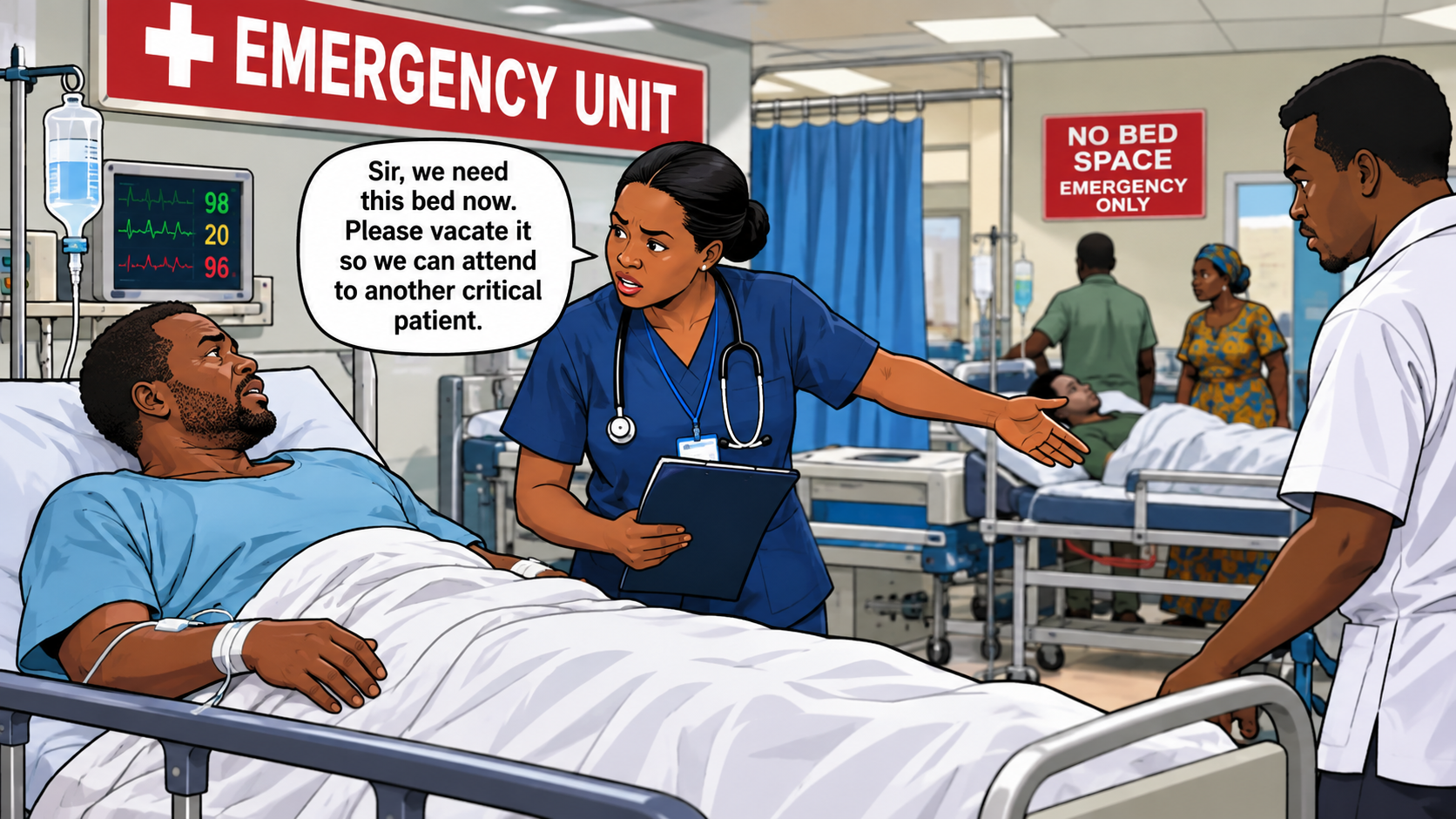
What about ambulances?
An ambulance is supposed to save time.
But what happens when the ambulance reaches a hospital that cannot receive the patient?
The ambulance can become part of the delay.
Nigeria has recognised the need to strengthen emergency transportation.
The Federal Government has been expanding emergency medical and ambulance services, including the introduction of additional ambulances and emergency-response infrastructure.
These efforts are welcome.
But there is a simple truth:
A faster ambulance cannot solve a hospital-capacity problem.
If the ambulance arrives at a hospital with no available emergency capacity, the journey simply starts again.
Nigeria therefore needs more than ambulances.
It needs a system that tells emergency teams where a patient can actually be received before the patient arrives.
Nigeria needs a national emergency bed dashboard
Imagine a different system.
An accident happens in Lagos.
The ambulance picks up the victim.
Instead of driving from hospital to hospital, the emergency control centre checks a live system.
It shows:
Hospital A — emergency bed available.
Hospital B — no bed.
Hospital C — ICU full.
Hospital D — trauma bed available.
The ambulance goes directly to Hospital D.
The hospital is already expecting the patient.
The medical team is ready.
Precious minutes are saved.
This is the kind of emergency coordination Nigeria needs.
Hospitals should be able to report their available:
- emergency beds;
- ICU beds;
- trauma beds;
- oxygen-supported beds;
- operating theatres;
- blood supplies;
- specialist services.
And that information should be accessible to emergency dispatch centres.
“No bed” must never mean “no help”
This should become a basic principle of emergency healthcare in Nigeria.
If a hospital genuinely has no admission bed, there must still be a clear process.
Assess the patient.
Stabilise the patient.
Contact another appropriate hospital.
Confirm that the receiving hospital can accept the patient.
Arrange safe transportation.
Continue emergency care during the referral process.
What should not happen is simply sending a critically ill person and their frightened family back onto the road with the instruction:
“Go somewhere else.”
Because “somewhere else” may be several kilometres away.
And the patient may not have several hours.
0 COMMENTS



















Leave a Reply