

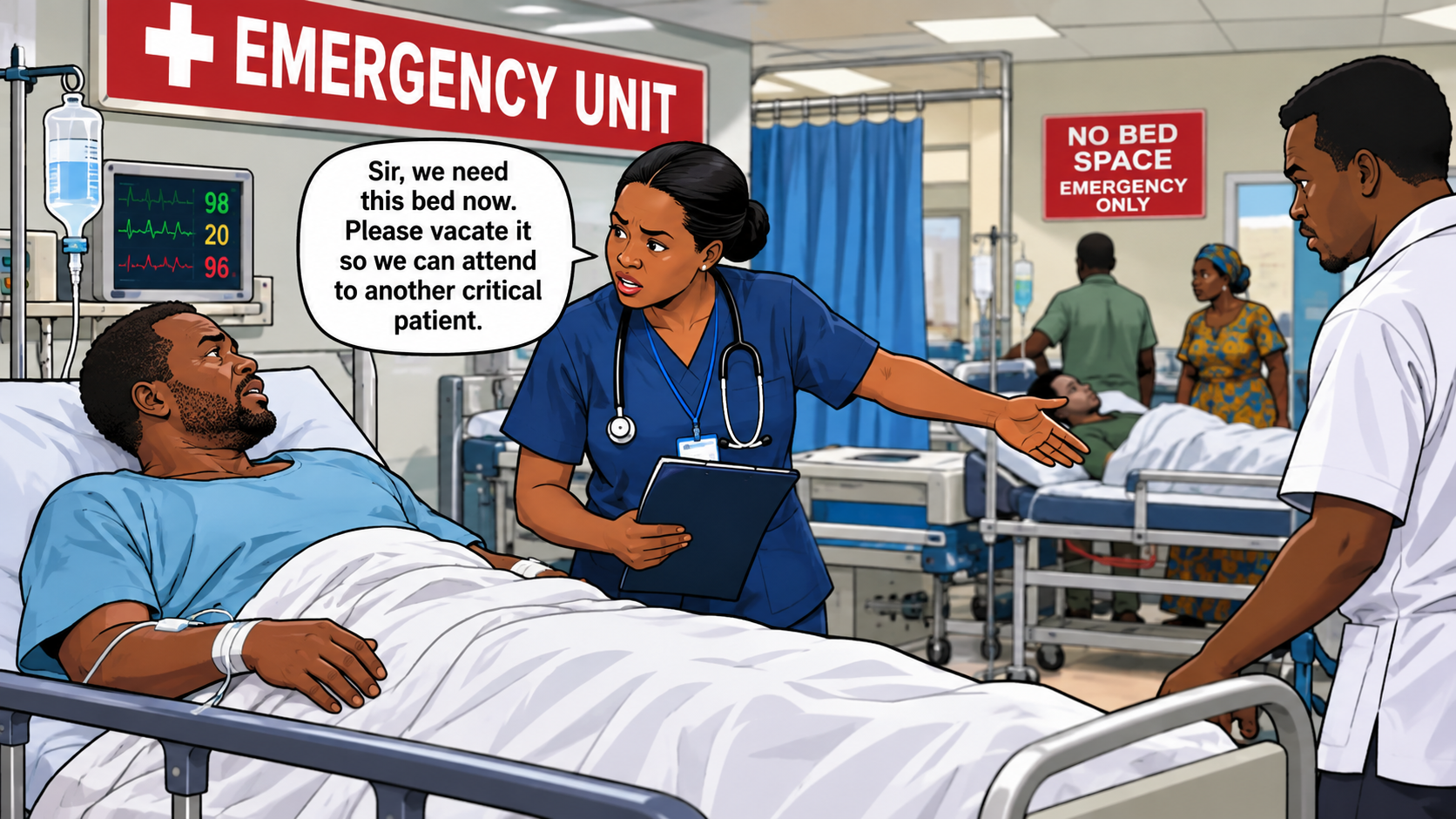
The real cost is paid by ordinary families
Behind every bed-space story is a family.
A father carrying his child.
A mother holding her sick daughter.
A husband desperately looking for help for his wife.
A son driving through the night with an unconscious parent.
They are not thinking about health-sector policy.
They are not thinking about hospital management.
They simply want one thing:
Save this person.
When they are told there is no bed, panic begins.
They call relatives.
They borrow money.
They search online.
They drive to another hospital.
They plead.
They wait.
And sometimes they return home with the person they brought out alive.
But not alive anymore.
This is not an attack on Nigerian doctors
Monafrika believes this conversation must be handled carefully.
Nigeria’s healthcare workers deserve support.
Many doctors, nurses, paramedics and other healthcare professionals work in difficult conditions.
The problem is bigger than individual workers.
It is a problem of healthcare capacity and emergency coordination.
Nigeria needs more beds.
But it also needs more trained healthcare workers.
It needs better-equipped emergency units.
It needs stronger primary healthcare.
It needs functional referral networks.
It needs more emergency ambulances.
It needs better blood and oxygen availability.
And it needs accountability when emergency care fails.
The uncomfortable question
Nigeria has laws saying emergency patients should not be refused treatment.
Nigeria has doctors.
Nigeria has hospitals.
Nigeria has ambulances.
Nigeria has medical schools producing healthcare professionals.
Nigeria has government programmes aimed at improving emergency care.
So why does a critically ill patient still sometimes arrive at a hospital and hear:
“No bed.”
That is the question policymakers must answer.
Not after another tragedy.
Not after another viral video.
Not after another grieving family goes to the media.
Now.
Because emergency medicine is about time.
And when time is lost, it cannot be recovered.
A bed should not become a death sentence
There is no reliable national figure showing exactly how many Nigerians have died specifically because they were refused admission for lack of bed space.
That distinction matters.
Not every death following a hospital referral was caused by bed shortages.
Not every allegation against a hospital is automatically proven.
But there is enough evidence from research, government reports, hospital investigations, and repeated media accounts to show that overcrowding, inadequate bed capacity, and delays in emergency care are serious problems in Nigeria.
And every unnecessary delay deserves attention.
Because behind the statistics are real people.
Real families.
Real names.
Real grief.
The words “no bed” should never be allowed to become the final chapter of a Nigerian patient’s story.
If a hospital cannot admit a critically ill patient, the system must immediately answer another question:
“Where can this patient be treated — and how do we get them there alive?”
That is not asking for too much.
It is the minimum a functioning emergency healthcare system should provide.
0 COMMENTS

















Leave a Reply