

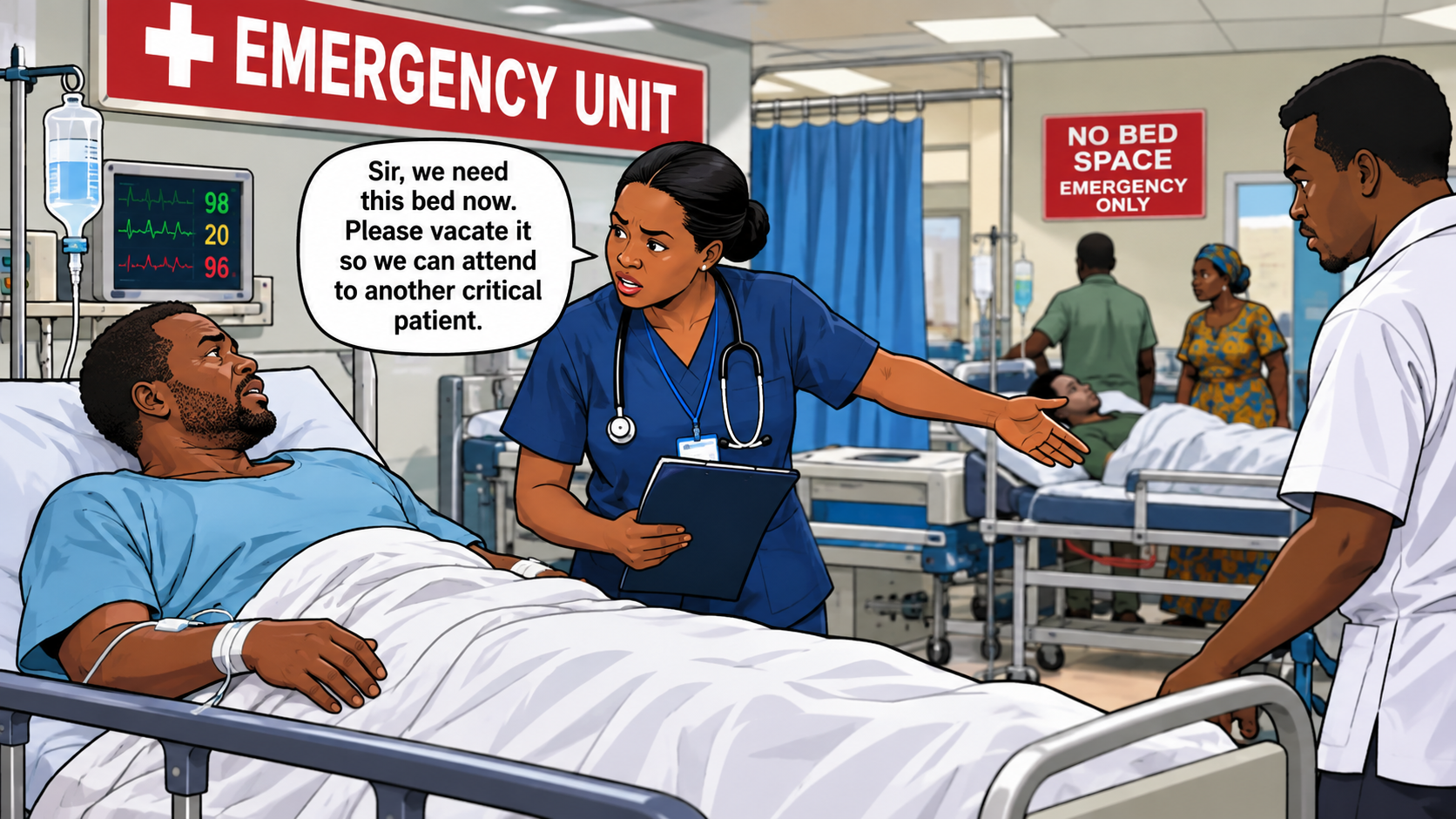
When the search moves from hospital to hospital
Deborah’s case is not the only reported example.
In Lagos, Daily Trust reported the case of a woman whose husband said she was rejected by several hospitals because of bed-space problems.
The family reportedly searched through five hospitals looking for somewhere that could receive her.
By the time they found help, it was too late.
Stories like this reveal a major weakness in Nigeria’s emergency system.
A critically ill patient should not depend entirely on the family knowing which hospital has an available bed.
There should be a coordinated referral system.
The first hospital should be able to contact another facility.
The receiving hospital should know what is coming.
An ambulance should move the patient.
And treatment should continue throughout the process.
Instead, families can sometimes find themselves doing the work of an emergency coordination centre.
The accident victim turned away
Another reported case came from Bauchi.
In 2020, victims of a road crash were taken to the Abubakar Tafawa Balewa University Teaching Hospital.
According to an account from Federal Road Safety Corps officials reported by PUNCH, some victims were initially not received because of a lack of bed space.
One seriously injured boy reportedly died after treatment was delayed.
The hospital subsequently ordered an investigation into the incident.
The hospital’s leadership also reportedly directed that emergency patients should not simply be turned away and that they should receive first aid or stabilisation before referral where necessary.
That instruction is important.
Because not having a bed should not automatically mean not providing emergency care.
The problem is bigger than one hospital
It would be wrong to suggest that only one hospital or one state is responsible for this problem.
Evidence from researchers shows that overcrowding and inadequate capacity are widespread problems in Nigeria’s emergency departments.
A study published in the Annals of Medicine and Surgery identified hospital bed shortages and overcrowding as significant problems affecting emergency care in Nigeria.
The study noted that Nigeria had an estimated 0.9 hospital beds per 1,000 people, compared with a global average of about 2.3 beds per 1,000 people at the time of the study.
The researchers linked overcrowding with delays and difficulties in providing timely emergency treatment.
Another study examining three Nigerian referral hospitals found that emergency departments were overcrowded several times each week.
The researchers identified several causes, including:
- too many critically ill patients;
- delays moving admitted patients from emergency units to wards;
- delays in surgery;
- delays in investigations;
- and inadequate bed capacity.
In simple terms, the problem is not only “not enough beds.”
Sometimes beds are occupied because patients who should have moved to wards or other facilities remain in emergency units for too long.
That creates a dangerous bottleneck.
0 COMMENTS


















Leave a Reply