

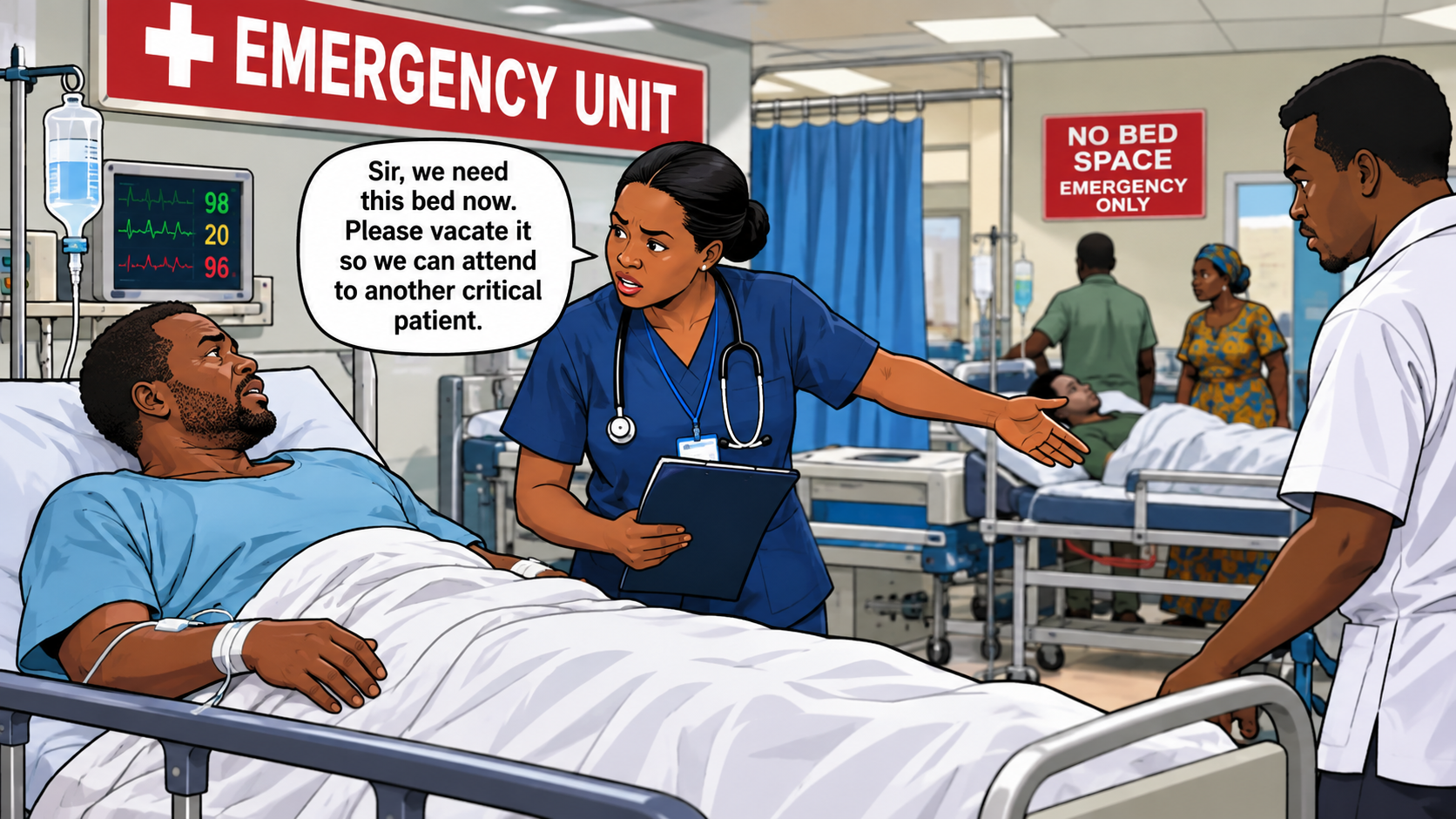
The emergency room is a race against time
For many emergencies, time matters.
A person suffering from severe bleeding cannot simply wait for several hours.
Neither can someone experiencing a major trauma, serious breathing difficulty or certain forms of stroke and heart-related emergencies.
A study at University College Hospital, Ibadan, looked at more than 10,700 emergency patients.
Researchers recorded 647 deaths.
About three-quarters of those deaths occurred within the first 24 hours of arrival.
This does not mean those patients died because the hospital lacked beds.
Many patients arrive at hospitals already critically ill.
But the finding demonstrates why delays in emergency care deserve serious attention.
When a patient is already at the edge, time becomes precious.
The doctors are also victims of the broken system
There is a danger in telling this story as if every doctor or nurse who says there is no bed is deliberately trying to deny a patient care.
That would be unfair.
Many Nigerian healthcare workers work under extreme pressure.
One emergency department may have dozens of patients competing for limited staff, equipment and beds.
There may be only a few nurses.
There may be too few doctors.
The intensive-care unit may already be full.
There may be shortages of oxygen, blood or essential equipment.
So when the system reaches capacity, healthcare workers can also become trapped.
This is why the solution cannot simply be:
“Punish the doctor.”
The bigger question is:
“Why does the system repeatedly place healthcare workers in a situation where they cannot safely accommodate the next emergency?”
The forgotten problem: primary healthcare
Nigeria’s biggest hospitals are also carrying patients who should ideally have been treated at lower levels of care.
When primary healthcare centres are poorly equipped or lack personnel, patients bypass them.
They head directly to secondary and tertiary hospitals.
That creates overcrowding.
A 2025 Premium Times report quoted healthcare professionals and patients describing overcrowding in Nigerian tertiary hospitals and linked part of the problem to weak primary healthcare facilities.
Some healthcare professionals said patients could move between two or three tertiary hospitals without finding admission space.
This creates a chain reaction:
Weak primary healthcare → overcrowded general hospitals → overcrowded teaching hospitals → fewer available beds → delayed treatment → emergency referrals → more delays.
And somewhere in the middle of that chain is a sick Nigerian who simply needs help
0 COMMENTS

















Leave a Reply