

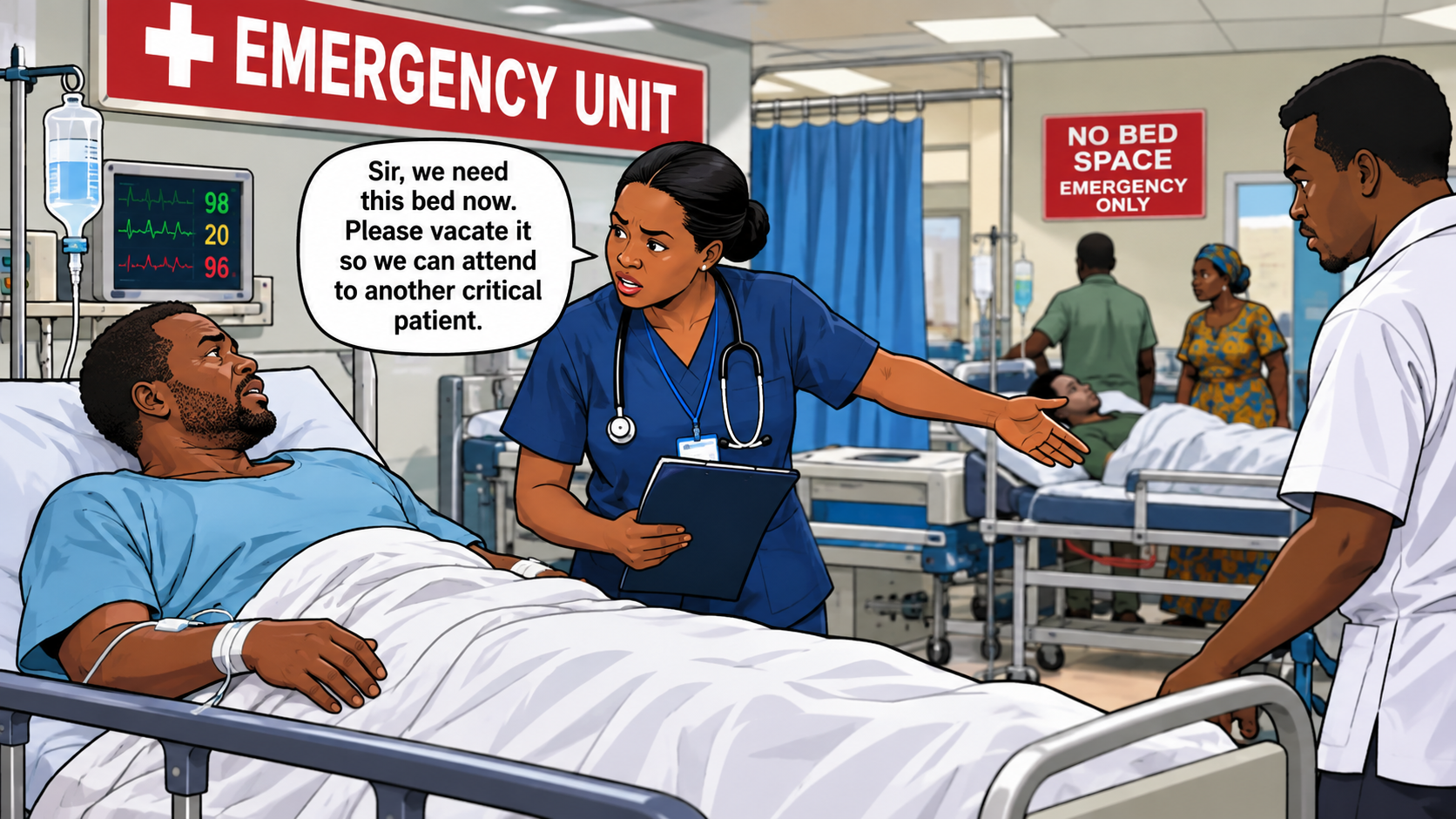
Across Nigeria, patients in critical condition are sometimes moved from one hospital to another after being told there is no bed space. The bigger question is: what happens to the patient while the family is searching for one?
There are few things more frightening for a family than rushing a loved one to a hospital during a medical emergency.
You arrive believing that help is finally close.
Then you hear two words:
“No bed.”
You plead.
You explain how sick the patient is.
You ask if something can be done while waiting for a bed.
Sometimes the family is told to try another hospital.
And the search begins.
One hospital.
Then another.
Then another.
For a patient whose life may depend on minutes, every additional journey can become dangerous.
For some Nigerian families, the search eventually ends with treatment.
For others, it ends with a death.
This is the disturbing reality behind the words “no bed space” in parts of Nigeria’s healthcare system.
When a hospital has no bed, what happens to the patient?
A hospital cannot create a bed when every available space is occupied.
Doctors and nurses also cannot safely admit unlimited numbers of patients.
But the problem becomes much more serious when the patient is experiencing a life-threatening emergency.
Nigeria’s National Health Act 2014 is clear on this point.
Section 20 says a healthcare provider, healthcare worker or health establishment shall not refuse a person emergency medical treatment for any reason.
The law recognises that emergency care cannot simply wait for administrative convenience.
But reports from different parts of the country show that the reality can be very different.
And that gap between the law and what happens at the hospital door is where the real tragedy begins.
The young woman who died at LUTH
In March 2023, the story of a young University of Port Harcourt student brought the issue into sharp focus.
Deborah Doofan, 20, was reportedly taken to Lagos University Teaching Hospital, LUTH, during a medical emergency.
According to her brother, the family arrived at about 2 am.
A doctor reportedly examined her but told the family that there was no available bed.
The family, according to the account published by PUNCH, pleaded for treatment while they waited.
They were reportedly even willing to allow her to be treated on the floor.
But the family said the situation did not improve.
Deborah eventually died outside the emergency ward.
LUTH management disputed aspects of the family’s account and said critically ill patients should be given appropriate options for referral.
The hospital also acknowledged the seriousness of the incident.
The case raised a painful question:
If a hospital has no bed, what responsibility does it still have toward a critically ill person standing at its emergency door?
That question remains central to Nigeria’s emergency-care debate.
0 COMMENTS



















Leave a Reply