
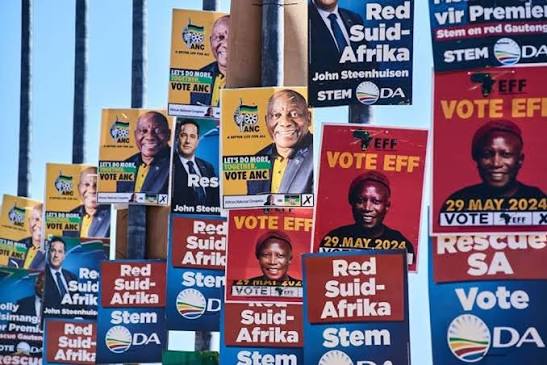
South Africa’s African National Congress (ANC), ActionSA, Economic Freedom Fighters (EFF) and former President Jacob Zuma’s uMkhonto weSizwe Party (MK) have moved towards a four-party coalition arrangement to govern Johannesburg, Tshwane and Ekurhuleni.
The agreement, reported on Monday, November 23, represents a significant political realignment following the country’s recent local elections.
ActionSA leader Herman Mashaba is expected to become Johannesburg’s mayor under the emerging arrangement, while the proposed structure would retain a substantial role for the ANC in municipal administration.
However, the coalition agreement should not yet be confused with completed mayoral elections or formal inauguration. Those steps remain necessary before the new leadership arrangements can be treated as operational.
Why the Democratic Alliance is being sidelined
The proposed arrangement is particularly significant because the Democratic Alliance (DA) recorded the highest vote share in Johannesburg and Tshwane but did not secure outright majorities.
In Johannesburg, Reuters reported that the DA received approximately 35 per cent of the vote, ahead of the ANC at 20 per cent and ActionSA at 16 per cent.
In Tshwane, the DA also emerged as the largest party, receiving 34.37 per cent, compared with ActionSA’s 22.07 per cent and the ANC’s 20.22 per cent.
Without an outright majority, parties must negotiate coalition arrangements to secure control of the municipal councils.
ActionSA consequently occupies an important position because its support can determine which parties form the governing administrations.
The DA made a separate attempt to reach an agreement with ActionSA, including an offer that would have allowed the incumbent Tshwane mayor, Nasiphi Moya, to remain in office.
However, ActionSA rejected the DA’s proposal.
A separate nationwide coalition proposal
The DA has also proposed a wider framework for cooperation with the ANC and Inkatha Freedom Party (IFP) across 137 hung municipalities.
Under its proposed arrangement, the ANC would lead 93 councils, the DA 24 and the IFP 20.
The proposal is intended to promote more stable municipal administrations and reduce the frequent collapse of coalition governments.
However, the national framework and the negotiations involving Johannesburg, Tshwane and Ekurhuleni are separate political arrangements.
The four-party Gauteng proposal is not yet a fully implemented national coalition agreement.
The real test: service delivery
The political negotiations are taking place against serious challenges in Johannesburg.
The city faces persistent water shortages, electricity problems, financial difficulties and waste-management challenges.
Level 2 water restrictions were introduced over the weekend, adding pressure to households and businesses.
The city has also experienced repeated political changes, with seven mayors since 2021, raising questions about administrative stability and continuity.
A new coalition will therefore have to demonstrate that its arrangements can provide more than political control of council positions.
Its programme will need to address infrastructure maintenance, water security, electricity reliability, municipal finances and the capacity of city institutions to deliver essential services.
The coalition negotiations have also exposed policy differences between the participating parties, particularly concerning migration and the role of municipal security institutions.
Monafrika Take
The proposed four-party agreement is an important political development, but the residents of Johannesburg, Tshwane and Ekurhuleni should judge the incoming administrations by their ability to improve municipal services. Coalition negotiations must translate into credible programmes for water, electricity, infrastructure and financial stability. Political compromises that merely distribute offices will not resolve the governance problems facing these cities.
0 COMMENTS







Leave a Reply